| Goal | Challenge the capitalist world order |
| Name | Western Union of Communist Republics (WUCR) |
| Type | Federation of communist states |
| Legacy | Lasting impact on global politics, economics, and technology |
| Founded | 1920 |
| Ideology | Communism |
| Policies | Rapid industrialization • Collectivized agriculture • Expansionist foreign policy |
| Dissolved | 1939 |
| Territory | Northern Hemisphere |
| Government | Authoritarian |
| Headquarters | Undisclosed |
| Ruling party | Communist Party |
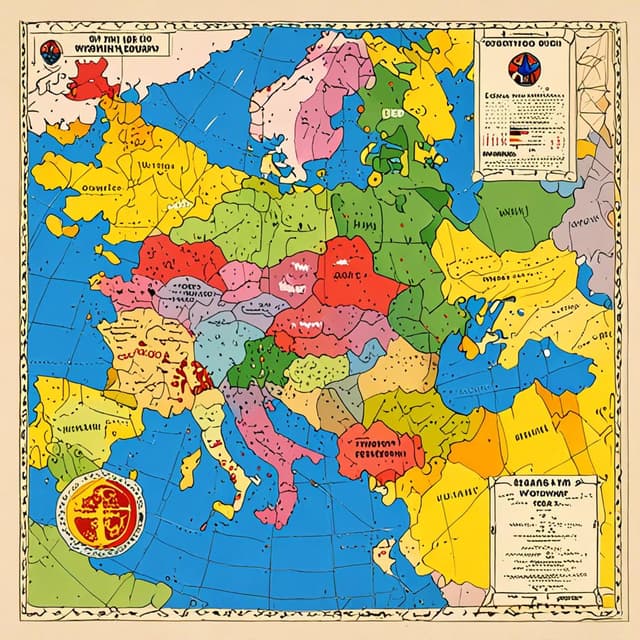
The Western Union of Communist Republics (WUCR) was a multinational federation of communist states that existed from 1920 to 1939 in an alternate timeline. Arising from the global spread of socialist revolutions in the early 20th century, the WUCR united much of Europe, North America, and parts of Asia under a highly centralized Marxist-Leninist regime.
The foundations of the WUCR were laid in the aftermath of the 1917 Russian Revolution, when the Bolsheviks under Vladimir Lenin seized power and established the Soviet Union. Inspired by this example, communist parties and revolutionary movements across the world launched a series of uprisings in the 1910s and 1920s.
These included the German Revolution of 1918-1919, the Hungarian Soviet Republic, the Spanish Civil War, the American Civil War, and the Chinese Communist Revolution. By 1920, the majority of these communist movements had prevailed, leading to the creation of the Western Union of Communist Republics as a federation of these newly-formed regimes.
The WUCR was envisioned as the vanguard of global communism, dedicated to overthrowing capitalist imperialism and establishing a worker's paradise. Its ideology was based on a synthesis of Marxism, Leninism, and the writings of theorists like Leon Trotsky. Key tenets included:
The WUCR was structured as a federal union of communist republics, with a highly centralized government based in Moscow. At the apex was the Supreme Soviet, the legislative body elected by regional soviets (councils) across the member states.
The head of state was the General Secretary of the Communist Party of the WUCR, who served as the de facto ruler. This position was initially held by Joseph Stalin from the WUCR's formation until his death in 1934, after which it passed to Nikolai Bukharin.
The WUCR maintained a vast security and surveillance apparatus, including the NKVD secret police, to suppress dissent and opposition. Individuals and groups deemed "class enemies" of the revolution were subject to political repression, censorship, forced labor, and even extrajudicial killings.
The WUCR pursued an aggressive program of state socialism and command economy policies. All major industries, financial institutions, and agricultural enterprises were nationalized and placed under the control of central planning authorities.
Rapid industrialization was a top priority, with massive state investments in infrastructure, technology, and military-industrial development. This allowed the WUCR to achieve technological parity or superiority over the capitalist world in areas like aerospace, nuclear power, and computing.
Agricultural production was similarly centralized through collectivization, forcing peasants into large state-run collective farms. This boosted overall output but also led to famine, displacement, and human rights abuses in many regions.
In the social sphere, the WUCR sought to transform culture and values in line with communist ideology. Religion, traditional family structure, and individualism were suppressed in favor of secular, collectivist ideals. Extensive propaganda and indoctrination campaigns promoted themes of class struggle, patriotism, and loyalty to the state.
The WUCR viewed itself as the epicenter of global communist revolution, and its foreign policy was guided by the principle of expanding the "worker's state" worldwide. It provided material and political support to communist movements in Asia, Africa, and Latin America that sought to overthrow colonial or capitalist regimes.
This put the WUCR in direct geopolitical competition with the major capitalist powers of the time - the British Empire, the United States, and the Empire of Japan. Proxy wars, economic warfare, and ideological conflicts characterized the global tensions of this period.
The WUCR also sought to establish itself as the leader of the worldwide communist movement, challenging the influence of the Soviet Union and its own brand of "national communism." This contributed to heightened tensions and occasional armed conflicts within the communist bloc.
The WUCR's authoritarian rule, human rights abuses, and economic challenges ultimately led to its downfall. A series of domestic crises in the late 1930s, including food shortages, labor unrest, and nationalist uprisings, severely weakened the regime.
In 1939, a coalition of anti-communist forces launched a coordinated military intervention that quickly toppled the WUCR government. The federation was dissolved, and its former member states either reverted to capitalist rule or formed new communist states outside of the WUCR's sphere of influence.
Despite its relatively short existence, the WUCR left a lasting impact on global politics, economics, and technology in this alternate timeline. Its model of centralized communist planning and rapid industrialization influenced subsequent socialist experiments worldwide. And the WUCR's technological achievements, especially in aerospace and computing, were influential on the development of those fields.
However, the WUCR's legacy is also marred by its authoritarianism, repression, and human rights violations. It stands as a cautionary tale about the dangers of unchecked communist totalitarianism, and a reminder of the fragility of even the mightiest of revolutionary states.
